
Trauma, Integration, and the Limits of Psychedelic Therapy
I joined Joe Moore on the Psychedelics Today podcast in a conversation about psychedelics, integration, and the future of the field


Joe Moore, Founder and CEO of Psychedelics Today, wrote an excellent summary of our conversation and the greater message of psychedelics as healing tools, and what it means for those of us who have struggled and are struggling with trauma.
Here’s part of his summary, from the Psychedelics Today web site. Please read the entire essay on the site, and please listen to the podcast:
🦋🦋🦋
What makes this episode stand out is Rex’s refusal to romanticize psychedelics.
She does not dismiss their value. She describes them as useful tools and, at times, therapeutic accelerants. But she rejects the idea that a single psychedelic experience resolves trauma, depression, or lifelong patterns on its own. Her view is more disciplined. Psychedelics may open a door, but the work that follows still belongs to the person. Joe’s questions help draw that out, especially when the conversation turns toward hype, psychiatry, integration, and the social structures around care.
Rex explains that her original interest in psychedelics came through reporting, not personal advocacy.
While living in England after cancer treatment, she encountered early psilocybin research coming out of Imperial College and began reporting on it for Scientific American Mind. That reporting led to conversations with Robin Carhart-Harris, Charles Grob, and Roland Griffiths, and eventually to her own participation in a clinical trial.
She also describes her training at Columbia University Graduate School of Journalism, where she deepened her science reporting skills and learned how to read studies closely and ask better questions. That background shapes the whole conversation. Rex is highly alert to sloppy claims, exaggerated results, and the tendency to market interventions before their limits are understood.
Much of the episode turns on Rex’s argument that psychedelic care has to take the whole person seriously.
She discusses the abuse she experienced in her family of origin and explains why that history became essential to both the book and her understanding of therapy. That experience also informs her critique of psychiatry when it reduces suffering to narrow treatment protocols or assumes that failed treatment means the patient failed.
A few core themes stand out:
Psychedelics can shift perspective, but they do not replace long-term work.
Integration is essential, not optional.
Community support helps prevent distortion, inflation, and confusion after powerful experiences.
Older psychedelic research still deserves serious attention.
Joe adds useful context throughout. He brings in examples from psychedelic culture, mentions concerns around HPPD, reflects on ketamine’s habit-forming potential, and raises problems with data integrity when people in trials also seek care underground. Those points widen the discussion without changing the central thread, which remains Rex’s critique of hype and shallow models of treatment.
🦗🦗🦗
In the final section, Rex argues that current psychedelic medicine risks becoming extractive, expensive, and overly medicalized.
She contrasts that model with community-based approaches that emphasize relationship, continuity, and collective processing. She points to traditions like UDV as examples of a structure where care does not end when the session ends.
Joe responds by describing his own interest in broader access, federal research pathways, and more community-oriented models of care. That contrast works well. Rex stays focused on what can go wrong when the field strips out integration and chases scalable profit, while Joe sketches some of the institutional pathways people are trying to build.
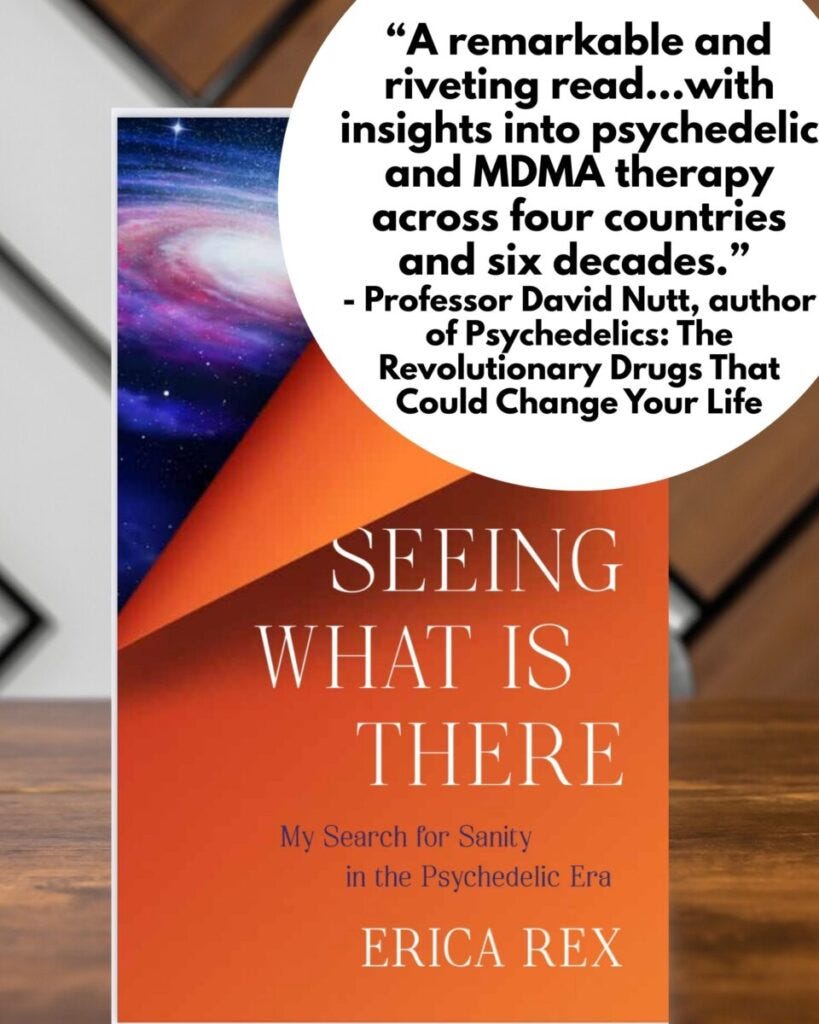
Seeing What Is There adds something rare to the psychedelic resurgence.
Erica Rex offers a careful, unsentimental account of what psychedelic work can open up, what it cannot do by itself, and what gets lost when the field confuses access, hype, and product delivery with actual care.
Erica on STATNews – I took part in a 2012 psilocybin trial. What I’m seeing now horrifies me
https://www.statnews.com/2026/02/19/psychedelic-therapy-more-than-just-drugs/
The Drug Science Podcast – Psychedelics, Power and the Price of Healing with Erica Rex
https://www.drugscience.org.uk/podcast/episode/4074c93b/145-psychedelics-power-and-the-price-of-healing-with-erica-rex
Book – https://www.simonandschuster.com/books/Seeing-What-Is-There/Erica-Rex/9798896360360
Audiobooks
https://www.audible.com/pd/Seeing-What-Is-There-Audiobook/B0FJJBJBCD
https://www.audiobooksnow.com/audiobook/seeing-what-is-there/10447857